

Why Governance Matters: The Hidden Cost of Misusing Low-Code ETL Tools in Enterprise Data Mesh

Low-code ETL tools like Alteryx, KNIME, and others were built to empower business users and analysts to solve data problems faster. In many ways, they’ve been successful. These tools offer drag-and-drop interfaces, easy data blending, and the ability to deliver insights quickly without writing code.
But in enterprise data setups, especially when moving towards Data Mesh and data product strategies, these tools can become silent threats if left unchecked.
In a recent internal discussion, one of our managers pointed out a harsh but necessary truth: We treat these tools like permanent solutions when they were meant to be temporary scaffolding. This sentiment strongly resonates with a post by Maverick Data, which articulates the risks clearly and calls out the need for strong governance.
What’s Going Wrong?
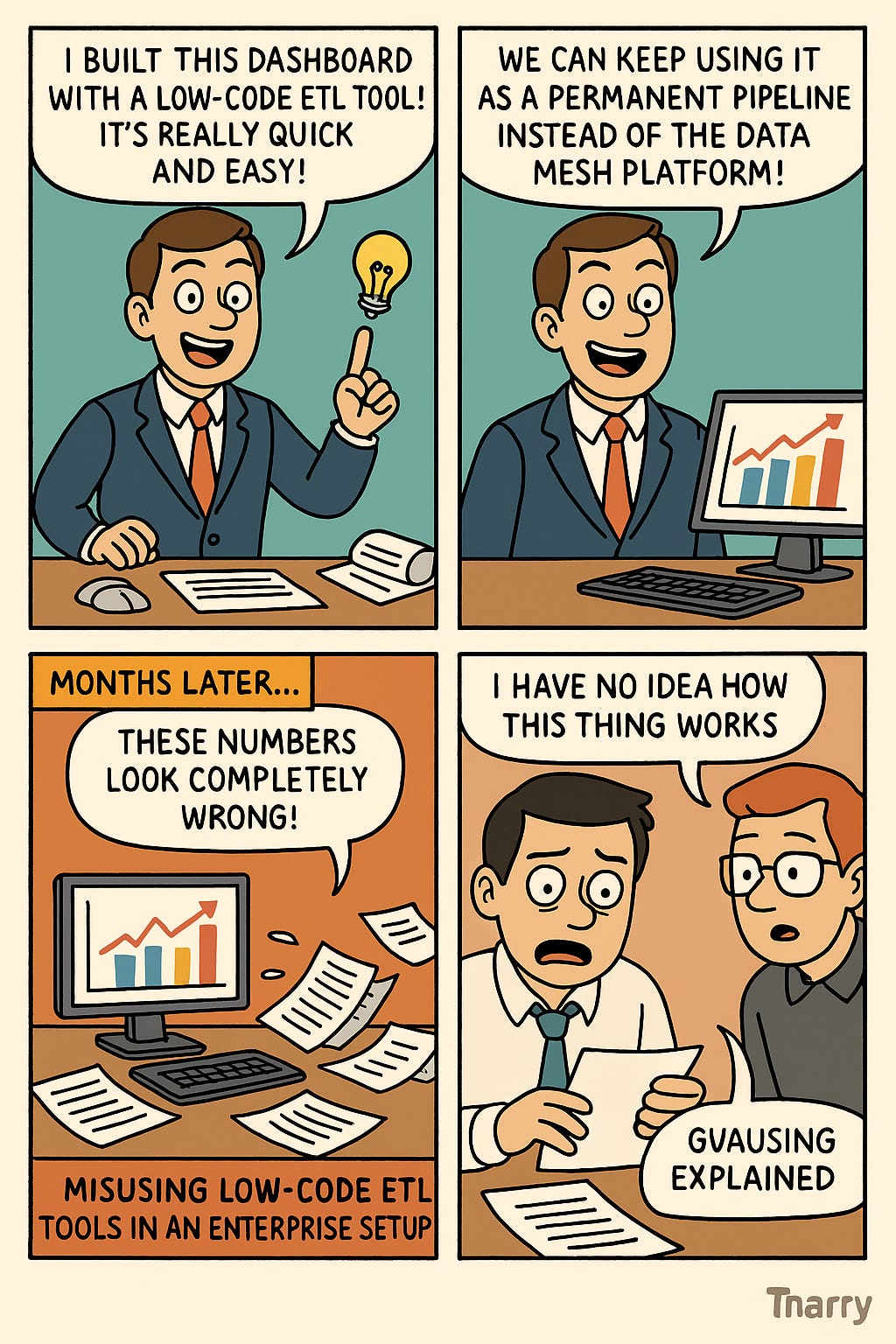
Let’s be clear: low-code ETL tools are not the villain. Misuse is the problem. Here’s what typically happens:
Business teams build flows locally to transform or clean data quickly for reporting.
Those flows remain unversioned and unmanaged.
Over time, these flows become the single source of truth for critical dashboards.
No one knows how it works anymore. No lineage. No ownership. No governance.
Eventually, you land in a place where:
Data lives in local silos.
Pipelines break silently.
There’s no central logging or monitoring.
Security and access controls are bypassed.
Debugging becomes a nightmare.
This is not data agility. This is end-user computing (EUC) chaos.
The Governance Gap
In a well-governed data mesh setup, each data product:
Has a clear owner.
Is discoverable, versioned, and auditable.
Follows data contracts and lineage tracking.
Integrates with CI/CD practices.
Low-code tools don’t naturally fit into this model unless very intentionally configured with governance in mind. Most teams don’t. Instead of acting as prototypes, these tools become permanent production pipelines often invisible to the central data platform or governance teams.
A Common Misuse Case
Let’s say a business analyst uses Alteryx to blend sales and CRM data to produce a weekly dashboard.
The flow is stored locally.
Credentials are embedded.
It’s not versioned.
The logic is known only to one person.
A few weeks later, they go on leave. A new manager demands changes. But no one knows what’s going on inside that .yxmd file. Even worse, the underlying data schema in the source system changes, and the Alteryx job silently fails, or worse continues running but with wrong data.
Fusion Teams? Yes. But with Handover.
There’s value in fusion teams , cross-functional squads where business and data engineers collaborate. Low-code tools work well in these settings if used for prototyping and properly handed over to engineering teams who rebuild the logic in governed environments (like dbt + CDW).
This is what modern analytics engineering looks like rapid iteration, followed by structured productionization.
The Cost of No Governance
Here’s what’s at stake if we don’t address this:

    Risk	                    Impact
Local storage	        Data gets lost, deleted, or outdated
No version control	No rollback or audit trail
Unapproved access	Data security and privacy concerns
No documentation	High onboarding and maintenance cost
No lineage tracking	Breaks trust in reports and KPIs
Manual scheduling	Leads to inconsistencies and delay

This becomes especially dangerous when data products are built on top of these loosely governed layers.
What Should We Do Instead?
Set clear policies for tool usage.
Define where low-code tools are allowed—and where they aren’t.
Educate business users on the risks of uncontrolled pipelines.
Encourage documentation and versioning even within these tools.
Integrate governance hooks like:
Saving flows in Git.
Creating lineage maps.
Using central scheduling and logging tools.
Use them as rapid prototyping tools only, with clear handoff to data engineering.
Rebuild stable flows in enterprise-grade systems like:
dbt
Azure Data Factory
Snowflake or Databricks with CI/CD
In Closing: It’s About Maturity, Not Blame
The tools are not inherently wrong. It’s about how we use them. Low-code ETL tools have their place. But in an enterprise-grade, data mesh-aligned setup with auditable, reusable data products, they must be used with caution and discipline.
Governance is the only way to ensure your data products don’t become fragile, unscalable one-person scripts. As more organizations embrace data mesh and product thinking, this conversation becomes non-negotiable.
Let’s move from quick wins to sustainable, governed outcomes.